No one can escape exposure to plastic from day to day. The production of plastic is a significant factor in the climate crisis as well as in the health of every living thing in our biosphere. Plastics, microplastics, and nanoplastics are everywhere: in the air we breathe, in the soil, in our oceans, in marine and terrestrial plants, in our food and our water, and even in the sediments at the bottom of the ocean. Teflon (banned in 2020) has been found in the flesh of polar bears.
Plastic production is the fifth largest contributor to the emissions that are rapidly heating our planet preceded only by the emissions of the U. S. A., India, China and Japan. The production, transportation, and extraction of petroleum also contribute to the role of plastic in the climate crisis.
Mathew Campen, PhD at the University of New Mexico, reported in 2024 that microplastics were found in every one of the 62 human placenta samples tested. (Toxicological Sciences, February 2024). Similarly, in 2024 the New England Journal of Medicine reported that the study of plaque taken from the carotid arteries of 304 patients showed that 60% contained polyethylene, the most widely used plastic that lines cup of your take-out coffee or tea. The list of medical issues related to plastic ingestion, inhalation, and absorption goes on: inflammation, endocrine disruption, cancer. Recently, dementia research has indicated that microplastics adversely affect neurological functions, including in the brain because microplastics can pass through the blood brain barrier (Frontiers in Neurology, May 30, 2025).
There’s more. The production of plastic involves the addition of various man-made, synthetic “forever” chemicals selected from a toxic “menu” of 16,325 (!) of which only 8% have been identified as non-hazardous! There is no data on 66%, and 26% have been identified as hazardous (Plastic Chem Report, 2024). California has started to measure the amounts of these chemicals in our drinking water by region this year, specifically PFAs. They are dubbed “forever” because that is how long they remain in our environment as a toxin.
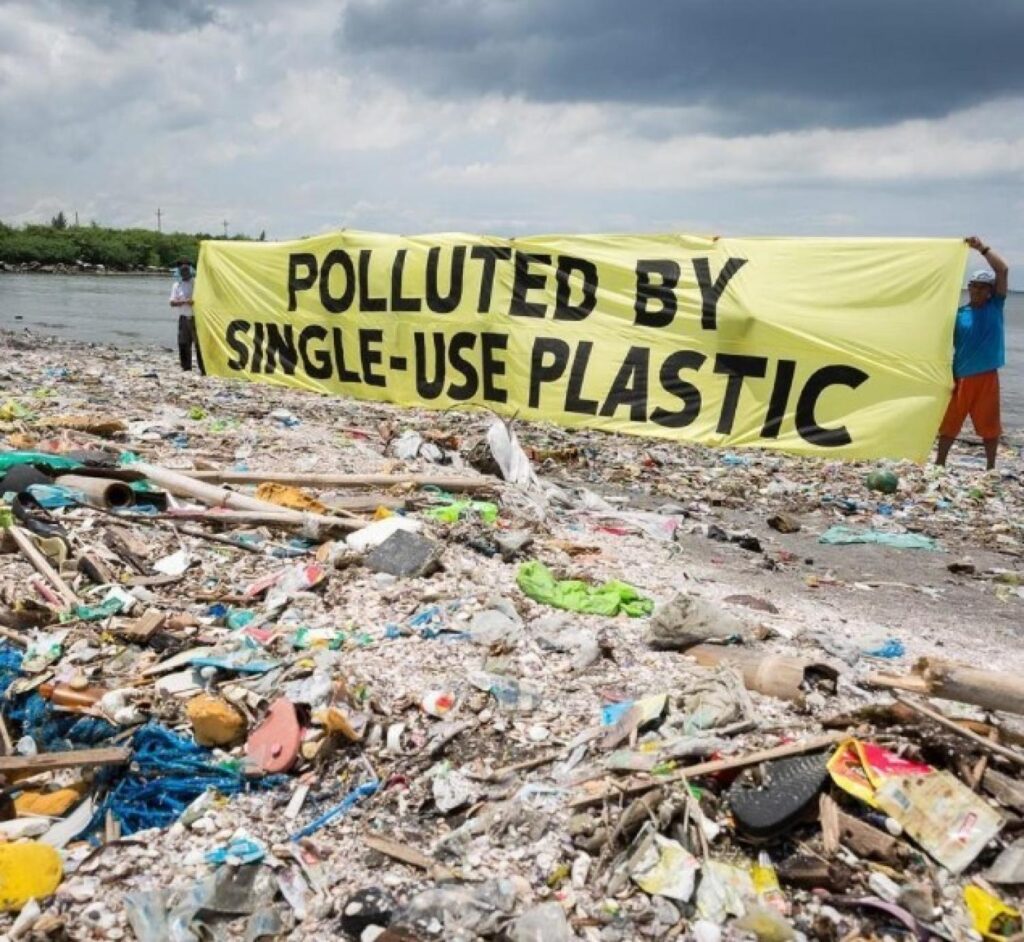
It has been estimated that about 50% of plastic pollution is caused by single use plastics that are used once and then thrown away. About 70% of plastic ends up in landfills, about 25% is burned (producing toxic gasses and ash), and about 5% is “recycled” (The Waste Wars: The Wild Afterlife of our Trash, Alexander Clapp, 2025). “Recycling” plastic is not profitable because, in general, 80% new, virgin plastic must be added to 20% of “recycled” plastic and the new plastic is less expensive than the “recycled” version.
Single use plastics comprise about 50% of the plastic pollution crisis and contribute significantly to the climate crisis. All of us have almost total control over the single use plastics that fill our lives. There are easy steps to take today. There is some inconvenience. However, new habits can prevail. Look at the picture above and imagine only half of the plastic.
Today, you can get stainless steel or aluminum water bottles and eliminate forever plastic water bottles; no plastic bags ever, bring your own fabric bags, cotton or canvas; use an insulated stainless steel coffee cup to replace paper coffee cups from the coffee store because the lining is polyethylene, a thermoplastic. These three replacement items must be washed regularly. . . an inconvenience? Is the planet worth it?
If you are ready to reduce the plastic in your life beyond the three replacements above, please see the Sierra Club’s excellent guide to reducing plastic room-by-room at:
https://www.sierraclub.org/Sierra/plastic-free-guide-room-by-room